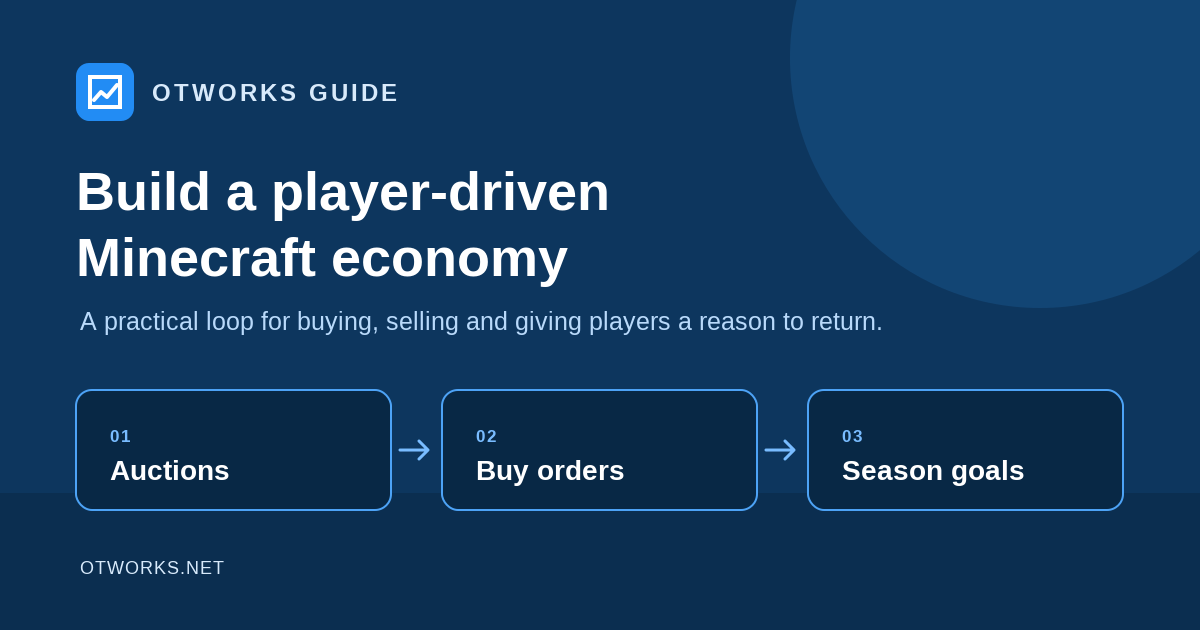
A server economy feels alive when players have useful things to trade, a clear way to find them and goals that bring them back. If every item only moves between a player and a shop, the market can start to feel like a chore.
A stronger loop has three parts: players list what they have, other players can ask for what they need, and longer-term goals make ordinary play feel worthwhile. You can build that loop gradually, using the systems that solve a real problem on your server.
Start with a market players can browse
When players can only sell to a server shop, the server sets the price and decides what is worth collecting. A player-run auction house gives them another option: list an item at a price they choose, then let other players decide whether it is worth buying.
OtAuctions gives players a searchable market with categories, sorting and a collection box. That makes it easier to find a specific item and gives sellers a straightforward way to turn spare materials or gear into currency.
Keep the first version simple. Pick a sensible listing duration, set clear limits and explain how sold items and unsold listings are returned. Review prices after launch before adding more rules. Players need room to trade, while staff need enough control to respond to abuse.
Let players create demand with buy orders
An auction house helps players sell what they already have. Buy orders solve the other half of the problem: a player can say what they want, how many they need and what they will pay per item. Other players can fill the order with part or all of the requested amount.
OtOrders reserves the buyer's money when the order is placed. Sellers are paid for each accepted delivery, and the items wait in the buyer's collection box. This gives gatherers a reason to bring materials to the market, even when nobody has listed that exact stack yet.
Set a maximum order size and duration that fit your server, then decide whether a creation fee or delivery tax makes sense. Fees can help manage spam, but they also make ordinary trades more expensive. Start with the smallest rule that solves a problem and adjust it using what players actually do.
Give regular play a longer-term goal
Markets create useful day-to-day activity. Seasonal goals give players something to work toward over a longer period. The key is to make progress come from normal play, rather than turning every activity into a race for the biggest payout.
OtPass adds daily, weekly and season quests, XP tiers and free and premium reward tracks. You can use it to set a rhythm for a season and give returning players clear milestones. Keep rewards aligned with your server: useful, understandable and balanced with the items already circulating in the economy.
If currency is already easy to earn, avoid making every quest a large money source. Consider items, cosmetics or access that adds variety without flooding the market. Tell players what is free, what is premium and how long the season lasts before it begins.
Roll it out in small steps
- Check the current economy. Note which items are scarce, what players buy from shops and where money enters or leaves the server.
- Launch one market feature first. Let players use the auction house or buy orders for a short period before adding more rules.
- Watch for friction. Look for confusing prices, abandoned listings, repeated spam or items that are suddenly much easier to obtain.
- Add seasonal goals when the basics work. Choose quest and reward settings that complement the economy, then explain the rules in-game and in your community.
If you run multiple servers, decide whether they should share a market or keep separate economies. Shared storage can connect the market across a network; separate markets give each mode more control over its own supply and prices.
Make the rules easy to trust
Players are more likely to use a market when they can understand what happens to their items and money. Publish the important limits, make fees visible before confirmation and explain what happens when an order expires or a listing does not sell. Ask a few players to try the flow before opening it to everyone.
Then make one change at a time. If prices rise, check which items are scarce and how much currency is entering the server. If players stop using the market, ask what feels slow or unclear before adding another tax. A healthy economy is built from feedback and small adjustments, not a long list of restrictions.
Choose the part your server needs next
You do not need to install all three systems at once. Start with the missing piece: player listings with OtAuctions, player-set demand with OtOrders, or seasonal progression with OtPass. Each product page has current compatibility details and setup information.
Browse all OtWorks products and build the economy your server actually needs.
 OtPass | Minecraft
 OtOrders | Minecraft
 OtAuctions | Minecraft